
Amsterdam Quiz: 10 Questions About the Dutch Capital
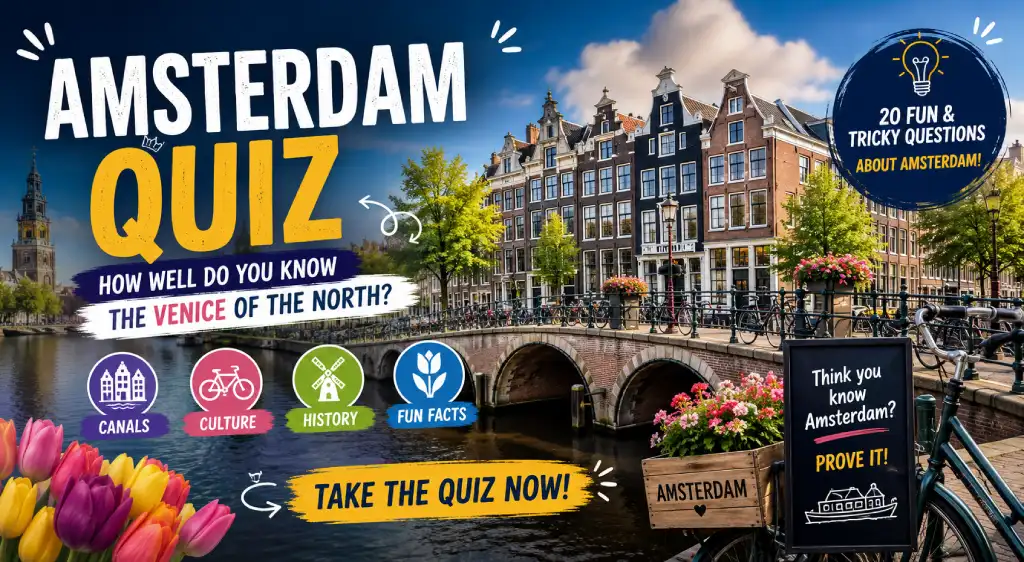
Amsterdam is the only city where you can get lost, find a canal, dodge a bicycle, and still think, “Wow… this is beautiful.” 😆🇳🇱
Take the ultimate Amsterdam trivia quiz! Put your knowledge to the test with fun questions covering top attractions, bikes, art history, and hidden secrets.
Start Amsterdam Quiz
🎯 Daily Trivia Challenge • 🧠 10 Questions • ⏱️ 90 Seconds
Amsterdam Quiz: Think You Know the City?
Amsterdam Trivia Questions, Test Your Knowledge, Netherlands Quiz
Amsterdam is one of those cities where you can turn a corner and suddenly find yourself staring at a centuries-old building, a quiet canal, or a bicycle that seems to have more confidence than you do. And here's another Amsterdam fact worth remembering: the city has so many bikes that sometimes it feels like the bicycles are the locals and people are just visiting. 🚲
Why did the tourist in Amsterdam keep looking up?
Because with all those bicycles coming from every direction, the sky felt like the safest place to look! 🚲😂
This Amsterdam quiz takes a closer look at the Dutch capital through its history, canals, architecture, museums, neighborhoods, royal connections, food, famous landmarks, and everyday culture. Forget the postcard version of Amsterdam for a moment. The real city has a few surprises waiting for you.
Before the Questions: Your Amsterdam Mission
Think of this as a small journey through Amsterdam rather than a list of random trivia questions.
We'll start with the city's origins, move through the famous canal belt, stop by some legendary landmarks, investigate the bicycle obsession, wander through historic neighborhoods, and finish with a few facts that even frequent visitors may not know.
Your job is simple:
Read the clues. Remember the details. Then trust your best guess.
And please don't choose an answer just because it sounds Dutch.
That strategy gets surprisingly dangerous.
1. Amsterdam's Beginning: A City Built Around Water
Amsterdam's story begins with water.
The name Amsterdam is connected to the Amstel River and a dam built across it. The settlement grew around this strategic location and eventually developed into one of Europe's most important trading cities.
During the Dutch Golden Age in the 17th century, Amsterdam became a major center of international commerce, finance, shipping, and culture.
The city you see today still carries traces of that period in its narrow streets, merchant houses, warehouses, canals, and historic buildings.
Quiz clue: If you see “Amstel” and “dam” in the same question, you're probably already halfway to the answer.
2. The Canal Belt: Amsterdam's Famous Waterways
Amsterdam's canals are probably the city's most recognizable feature.
The historic canal system expanded dramatically during the 17th century as Amsterdam grew into a major international trading center.
The Canal Ring, known as the Grachtengordel, includes several major canals arranged in a distinctive pattern around the old city center.
Herengracht, Keizersgracht, and Prinsengracht are among the best-known canals.
These waterways weren't built simply because someone thought canals looked pretty.
They had practical purposes involving transportation, trade, urban planning, and water management.
Amsterdam essentially turned engineering into scenery.
3. Why Are Amsterdam's Houses So Narrow?
One of the first things visitors notice is Amsterdam's collection of tall, narrow canal houses.
There is a historical reason for their unusual proportions.
Limited space and historical taxation rules helped encourage narrow building plots, particularly along valuable canal-front property.
Many historic houses also have hooks or hoisting beams near the top.
Why?
Because moving large furniture through a tiny staircase is not exactly a relaxing weekend activity.
The external hoisting system allowed goods and furniture to be lifted through windows.
So if you see a canal house with a hook near the roof, don't assume it's decoration.
Amsterdam was solving a very practical problem.
4. The Dutch Golden Age: Amsterdam Gets Seriously Important
The 17th century was a defining period in Amsterdam's history.
During the Dutch Golden Age, the city became a major international center for commerce, shipping, banking, science, publishing, and art.
Dutch merchants traded across large parts of the world, while Amsterdam's financial institutions helped establish the city as one of Europe's major economic centers.
The wealth generated during this period helped shape the grand canal houses and urban expansion that still define parts of Amsterdam.
A good Amsterdam quiz should absolutely include the Golden Age.
Otherwise, we're basically talking about the city without explaining how it became the city.
5. Rijksmuseum: A Giant House of Dutch Art
If Amsterdam had a museum heavyweight championship, the Rijksmuseum would be one of the obvious contenders.
The museum houses an enormous collection of Dutch art and history.
Among its most famous works is Rembrandt's The Night Watch, one of the best-known paintings in the Dutch collection.
The museum also contains works by artists such as Johannes Vermeer and Frans Hals.
But don't make the mistake of thinking the Rijksmuseum is only about paintings.
Its collection covers centuries of Dutch history, decorative arts, objects, and cultural heritage.
Quiz tip: Rembrandt + Amsterdam + The Night Watch = Rijksmuseum.
That combination is worth remembering.
6. Van Gogh Museum: Meet the Artist Behind the Name
Amsterdam is also home to the Van Gogh Museum, which contains the world's largest collection of works by Vincent van Gogh.
The museum offers an extensive look at his paintings, drawings, letters, and artistic development.
Van Gogh's life was relatively short, but his work became enormously influential after his death.
The museum allows visitors to see how his style changed over time and how his use of color, brushwork, and subject matter developed.
For quiz purposes, remember:
Van Gogh Museum = Vincent van Gogh.
Simple?
Yes.
But once four answer choices are staring back at you, suddenly nothing is simple.
7. Anne Frank House: A Powerful Piece of History
The Anne Frank House is one of Amsterdam's most significant historical sites.
It is located in the building where Anne Frank and her family hid during the Nazi occupation of the Netherlands during World War II.
Anne Frank's diary became one of the world's most widely read firsthand accounts of life during the Holocaust.
The museum preserves the history of the hiding place and the people connected to it.
This is one of the places where an Amsterdam quiz should slow down.
Not every interesting fact about the city is lighthearted.
Some are important because they help us remember history.
8. Dam Square: The Center of the Action
Dam Square sits in the historic heart of Amsterdam.
The square is surrounded by major landmarks, including the Royal Palace Amsterdam and the Nieuwe Kerk.
It has been an important gathering place for centuries and remains one of the city's busiest public spaces.
The name “Dam Square” also gives another clue to Amsterdam's origins.
The original settlement developed around a dam on the Amstel River.
So yes, Amsterdam's most famous square is connected to the same piece of engineering that helped give the city its name.
9. The Royal Palace Amsterdam
The Royal Palace on Dam Square has a fascinating history.
It was originally constructed as Amsterdam's city hall during the Dutch Golden Age.
Later, it became a royal palace.
The building's impressive interior reflects the wealth and ambition of 17th-century Amsterdam.
One particularly interesting detail is that the building was designed during a period when Amsterdam was becoming one of Europe's most important commercial cities.
In other words, this wasn't originally built as a royal residence.
It started life as a very ambitious city hall.
Amsterdam apparently didn't believe in doing things halfway.
10. Amsterdam and Bicycles: A Serious Relationship
Now we arrive at the subject that can make visitors nervous:
bicycles.
Cycling is deeply embedded in everyday life in Amsterdam.
The city has an extensive network of bike paths and cycling infrastructure, and bicycles are one of the most common ways people move around.
If you're visiting Amsterdam, remember that a bicycle bell is not necessarily a friendly greeting.
Sometimes it means:
“Please move before we both become part of a traffic experiment.”
For a quiz, look for clues involving cycling, bike lanes, bicycle parking, and Dutch urban transportation.
11. Jordaan: One of Amsterdam's Most Beloved Neighborhoods
The Jordaan is one of Amsterdam's most recognizable historic neighborhoods.
It was originally developed as a working-class area and has changed considerably over the centuries.
Today, its narrow streets, canals, independent shops, cafés, galleries, and historic buildings make it one of the city's most popular areas.
The neighborhood has a more intimate atmosphere than some of Amsterdam's major tourist streets.
If the quiz asks you to identify a charming historic Amsterdam neighborhood filled with small streets and canals, Jordaan is a strong candidate.
12. De Pijp: Food, Markets, and City Life
De Pijp has a very different personality.
The neighborhood is known for restaurants, cafés, bars, international influences, and the famous Albert Cuyp Market.
The market has operated for generations and is one of Amsterdam's best-known street markets.
You can find food, clothing, flowers, snacks, and all sorts of everyday goods.
De Pijp is a useful reminder that Amsterdam isn't just museums and historic houses.
It's also a living city where people shop for lunch while tourists are busy taking pictures of bicycles.
13. Amsterdam's Famous Markets
Markets have played an important role in Amsterdam's daily life for centuries.
The Albert Cuyp Market is one of the best-known, while flower markets and other neighborhood markets add to the city's lively street culture.
Amsterdam's markets are also a great place to encounter Dutch snacks.
If you see something called stroopwafel, you have found one of the Netherlands' most famous sweet treats.
Two thin waffles.
Sweet syrup in the middle.
A very effective reason to forget that you were supposedly “just looking.”
14. Dutch Food: Don't Leave Without Trying Something
Dutch cuisine may not receive as much international attention as French or Italian food, but Amsterdam has plenty of local specialties worth knowing.
Stroopwafels are perhaps the city's most famous sweet snack.
Herring is another traditional Dutch food, often served with onions and pickles.
Then there are bitterballen, a popular Dutch snack often served in cafés and bars.
And don't forget Dutch cheeses.
Gouda and Edam are two names that have become famous far beyond the Netherlands.
If your Amsterdam quiz asks about local food, don't immediately search your brain for pizza.
Amsterdam has its own answers.
15. Amsterdam's Flower Connection
The Netherlands is famous for flowers, particularly tulips, and Amsterdam is closely associated with this national image.
The Bloemenmarkt, or Flower Market, is one of the city's best-known markets.
Tulips have a particularly interesting place in Dutch history.
During the 17th century, tulip bulbs became the focus of intense speculation in what is commonly known as “Tulip Mania.”
The episode has become one of the most famous stories in economic history.
So yes, a flower can become a quiz question about finance.
Only in the Netherlands.
16. The Amstel River: The City's Namesake
The Amstel River is central to Amsterdam's identity.
The settlement developed around the river and the dam that crossed it.
Today, the river still flows through the city and passes several important landmarks and neighborhoods.
The name Amsterdam essentially reflects this relationship between the Amstel and the dam.
If a quiz asks:
“Where does the name Amsterdam come from?”
Think water.
Think Amstel.
Think dam.
You have your answer.
17. Amsterdam's Floating and Water-Based Life
Water is so deeply integrated into Amsterdam that it isn't unusual to see houseboats along the canals.
Houseboats became increasingly popular during the 20th century and remain a distinctive part of the city's residential landscape.
The canals are also used for sightseeing cruises, transportation, recreation, and everyday urban life.
Amsterdam isn't merely a city that happens to have canals.
The canals are part of the city's identity.
Some cities have streets.
Amsterdam basically said:
“Let's add water.”
18. The Begijnhof: A Quiet Corner in the City
The Begijnhof is one of Amsterdam's historic enclosed courtyards.
It dates back to the Middle Ages and was associated with the Beguines, a community of religious women.
Today, the courtyard provides an unexpectedly peaceful space in the middle of the busy city center.
Its historic houses and quiet atmosphere make it easy to forget that you're only a short distance from Amsterdam's busiest streets.
This is exactly the kind of place that makes a good quiz fact.
Not because everyone knows it.
Because most people don't.
19. Amsterdam's Museum Quarter
Amsterdam's Museum Quarter, or Museumplein, is home to several of the city's major cultural institutions.
The Rijksmuseum, Van Gogh Museum, and Stedelijk Museum are all located around this area.
The neighborhood became one of Amsterdam's major cultural destinations and is a natural stop for anyone interested in art and history.
For quiz purposes, remember the trio:
Rijksmuseum — Dutch art and history
Van Gogh Museum — Vincent van Gogh
Stedelijk Museum — modern and contemporary art
Three museums.
Three very different identities.
20. Amsterdam Today: Old City, Modern Life
What makes Amsterdam particularly interesting is the contrast between its past and present.
Historic canal houses stand beside modern businesses.
Centuries-old churches sit near contemporary cafés.
Traditional markets share streets with international restaurants.
Bicycles move alongside trams, buses, cars, and pedestrians.
Amsterdam has managed to preserve a remarkable amount of its historic character while remaining a busy modern European capital.
And that's probably the best way to approach this quiz.
Don't think of Amsterdam as one single thing.
Think of it as several centuries of history packed into one city.
Amsterdam Quick Facts
Amsterdam is the capital of the Netherlands.
The city's name is connected to the Amstel River and a historic dam.
Amsterdam's famous canal belt expanded significantly during the 17th century.
The 17th century Dutch Golden Age played a major role in the city's development.
The Rijksmuseum is home to The Night Watch by Rembrandt.
The Van Gogh Museum holds the world's largest collection of works by Vincent van Gogh.
The Anne Frank House is located in the historic building where Anne Frank and others hid during World War II.
Dam Square is located in the historic city center.
The Royal Palace Amsterdam was originally built as Amsterdam's city hall.
Cycling is a major part of everyday transportation in Amsterdam.
Jordaan is one of the city's best-known historic neighborhoods.
De Pijp is known for the Albert Cuyp Market and its lively food scene.
Stroopwafels are one of the Netherlands' best-known sweet treats.
The Netherlands is famous for tulips and flower cultivation.
The Amstel River runs through Amsterdam.
Houseboats are a distinctive part of Amsterdam's canal landscape.
Begijnhof is one of the city's historic enclosed courtyards.
Museumplein is home to several major Amsterdam museums.
Your Amsterdam Quiz Starts Here
You've now walked through Amsterdam's canals, history, museums, markets, neighborhoods, architecture, food, and bicycle-filled streets.
Now let's see what actually stuck.
Maybe you know Amsterdam like a local.
Maybe you know the city mostly from travel photos.
Or maybe you've just learned that the Royal Palace wasn't originally built as a palace.
Whatever your level, the real test starts now.
Take the 20-question Amsterdam quiz and find out how well you really know the Dutch capital.
And remember:
If you get a question wrong, don't worry.
At least you didn't get hit by a bicycle.