
101 Mind-Blowing USA Facts & Local Oddities That Explain America
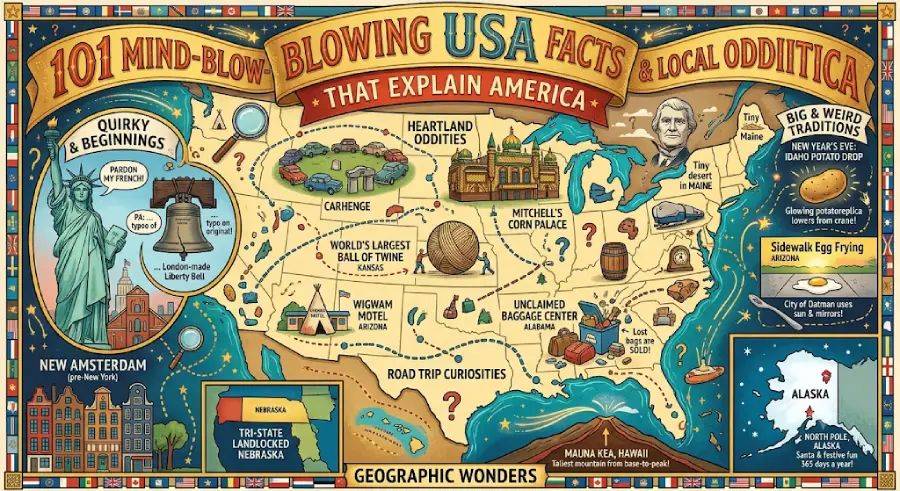
From towering redwoods and neon-lit metropolises to bizarre local laws, legendary fast-food origins, and untold historical secrets, the United States is a land of fascinating contrasts. Whether you are curious about iconic national landmarks, weird geography anomalies, or eccentric cultural traditions, here are 101 mind-blowing USA facts that explain the true history and identity of America.
101 Unbelievable Facts About the United States
Explore iconic landmarks, strange state laws, regional culinary history, and natural wonders across all 50 states.
1. Geography & Extreme Natural Wonders
Including its islands, Alaska boasts over 33,000 miles of coastline, dwarfing the tidal shoreline of the entire lower 48 states.
Furnace Creek in Death Valley, California, hit a record-breaking 134°F (56.7°C) in July 1913, remaining the official world record.
Yellowstone was established in 1872 as the world’s very first national park, paving the way for the National Park Service system.
A single drop of water starting at Lake Itasca in Minnesota takes roughly three months to reach the Gulf of Mexico.
The Four Corners Monument marks the exact boundary where Arizona, Colorado, New Mexico, and Utah intersect.
Combined, Superior, Michigan, Huron, Erie, and Ontario contain enough water to submerge the continental US under 9 feet of water.
With over 420 miles of surveyed underground passageways, no other subterranean network on Earth compares in length.
While Everest has the highest elevation above sea level, Mauna Kea measures over 33,500 feet from its underwater ocean base.
No other US states share boundaries with as many neighbors as Missouri and Tennessee.
From the Virgin Islands in the Atlantic to Guam and American Samoa in the Pacific, US territory spans nearly half the globe.
Towering at 20,310 feet, Denali rises higher from its surrounding terrain base than Mount Everest.
By volume, this giant sequoia stands 275 feet tall and measures over 52,000 cubic feet in total mass.
Formed by a collapsed volcano 7,700 years ago, Crater Lake reaches a staggering depth of 1,943 feet with pure rainwater.
Florida’s highest natural point, Britton Hill, sits at an elevation of just 345 feet above sea level.
Lake Superior holds 3 quadrillion gallons of water, enough to cover North and South America in 1 foot of water.
2. Iconic Food, Fast Food & Culinary Innovations
Ruth Wakefield added broken Nestlé chocolate pieces to butter cookie dough at the Toll House Inn in 1938, creating an American icon.
That equates to roughly 3 hamburgers per week for every single person living in the United States.
Chef George Crum created paper-thin fried potatoes after a picky customer complained his French fries were too thick.
Brothers Richard and Maurice McDonald launched their assembly-line drive-in hamburger stand in 1940 before Ray Kroc expanded it globally.
Formulated by pharmacist Charles Alderton in Waco, Texas in 1885, Dr Pepper predates Coca-Cola by one year.
San Francisco’s unique fog climate created wild local lactobacillus strains (*Lactobacillus sanfranciscensis*) that define sourdough flavor.
Made using small tart Key limes and sweetened condensed milk, Florida officially designated it the official state pie in 2006.
In 1964, Teressa Bellissimo deep-fried unjointed chicken wings and tossed them in cayenne hot sauce for her son’s late-night friends.
Featuring high-edged crusts filled with thick mozzarella cheese, coarse tomato sauce, and sausage, it revolutionized Italian-American food.
That amounts to roughly 350 slices of pizza eaten per second across the entire country.
3. History, Government & Presidential Mysteries
Robert G. Heft designed the flag in 1958 for a class project and originally received a B-grade before President Eisenhower adopted it.
The White House was completed during John Adams' presidency in 1800, after Washington had passed away.
Philadelphia served as the national capital from 1790 to 1800 while Washington D.C. was being constructed.
John Adams and Thomas Jefferson died on July 4, 1826 (the 50th anniversary of Independence), and James Monroe died on July 4, 1831.
Dubbed "Seward's Folly," the deal worked out to less than 2 cents per acre for massive timber, gold, and oil deposits.
Shipped across the Atlantic in 350 individual copper pieces packed into 214 crates, it was erected on Liberty Island in New York Harbor.
Before his presidency, Lincoln competed in roughly 300 matches and was only defeated once in county catch-as-catch-can contests.
Located in Philadelphia, the bell cracked during its initial test toll in 1752 and fractured permanently on George Washington’s birthday in 1846.
Drafted in 1787 and ratified in 1788, it has governed the nation for over 230 years with only 27 constitutional amendments.
Known as the "Mother of Presidents," eight US leaders—including Washington, Jefferson, Madison, and Monroe—were born in Virginia.
4. Iconic Landmarks, Architecture & Pop Culture
Due to the sheer volume of mail delivered to its 150 businesses, the landmark skyscraper requires its own dedicated postal code.
Erected in 1923 as an outdoor billboard advertisement for a real estate housing development, the last four letters were dropped in 1949.
Standing 630 feet tall, this stainless-steel arch commemorates the westward expansion of the United States.
With over 150,000 hotel rooms along the Strip, Las Vegas houses 15 of the world’s 25 largest resort hotels.
Established in 1926 from Chicago to Santa Monica, Route 66 became the Ultimate symbol of American road trip culture.
Located in Bloomington, Minnesota, it features an indoor theme park, aquarium, and over 500 retail stores.
Architects selected the distinct reddish sealant color to ensure the bridge remained visible to ships through heavy ocean fog.
Renamed in 1904 after The New York Times moved its headquarters into the building at One Times Square.
Sculpted in the Black Hills of South Dakota between 1927 and 1941, it depicts Washington, Jefferson, Roosevelt, and Lincoln.
Built by George Washington Vanderbilt II in Asheville, the French Renaissance château spans 178,926 square feet of floor space.
5. Weird State Laws & Quirky Local Customs
State law strictly outlaws bear wrestling matches, selling wild bears, or training bears to compete in sports.
Along with Alaska, Delaware, Montana, and New Hampshire, Oregon imposes 0% statewide general sales tax.
One of Vermont’s oddest archaic blue laws officially bans residents from whistling while submerged in water.
If you tie an elephant to a parking meter or payphone in Florida, municipal ordinances state you must pay the regular parking fee.
To protect the state's dairy industry, Wisconsin banned yellow-dyed margarine sales from 1895 until 1967.
While English is the primary spoken language, the US government has never declared an official national language.
Thanks to rich volcanic soil in the Kona district, Hawaii produces high-grade arabica coffee beans commercially.
Unlike the rest of the continental US split between Eastern and Western Interconnections, Texas maintains its own grid (ERCOT).
Because Saguaro cacti take over 75 years to grow arms, poaching or destroying one is a class 4 felony punishable by up to 3.75 years in prison.
Following the 19th-century silver and gold rush boom and bust cycles, Nevada boasts over 600 abandoned ghost towns.
6. Sports, Science, Industry & Economy (Items 56-101)
The Interstate Highway System alone, started under President Eisenhower in 1956, stretches nearly 49,000 miles.
Formalized by the Alexander Cartwright rules in 1845, baseball became deeply intertwined with US sports culture.
The building has such large volume (3.66 million cubic meters) that rain clouds can form near its ceiling on humid days.
If California were an independent country, its GDP would outrank Japan, India, and the United Kingdom.
Rescued from near extinction in the late 19th century, wild bison populations now thrive across national parks.
6. Sports, Science, Industry & Culture (Continued)
Canadian-born physical education instructor James Naismith created the game using a soccer ball and two peach baskets.
Its massive footprint covers 29 acres and includes 17.5 miles of corridors connecting its central departments.
In 1799, a 12-year-old boy found a 17-pound gold nugget in Cabarrus County, decades before the famous 1849 California gold rush.
Spanning 15 blocks of Hollywood Boulevard, the historic walkway honors icons across film, television, music, and radio.
USPS processes and delivers hundreds of billions of pieces of mail and packages to millions of residential addresses annually.
Carved by the Colorado River in Arizona, its immense scale stretches 277 miles long and up to 18 miles wide.
Based primarily in Washington D.C., it comprises 21 museums, 9 research centers, and the National Zoo.
Completed in Chicago in 1973, its iconic 1,450-foot skyscraper rooftop remains a cornerstone of American architecture.
Pineapples originated in South America and were introduced to the Hawaiian islands by Spanish explorers in the late 18th century.
Station KDKA aired the 1920 presidential election results, launching the golden age of American commercial broadcasting.
On December 17, 1903, Orville and Wilbur Wright successfully flew the Wright Flyer across the Outer Banks dunes.
The MTA subway network operates 24 hours a day, 365 days a year, serving millions of daily commuters across four boroughs.
Geologists monitor the underground volcanic caldera, which has produced three colossal eruptions over the past 2.1 million years.
Introduced in 2000, the golden dollar coin depicts the historic interpreter who accompanied the Lewis and Clark Expedition.
Because water flows into the lake but has no outlet, mineral evaporation leaves behind high saline concentrations.
Funded by the US Department of Defense, the initial packet-switching network connected UCLA and Stanford research computers.
Housing over 170 million items across thousands of miles of bookshelves, it serves as the research arm of the US Congress.
Dr. John Harvey Kellogg later patented a process for creating peanut paste from raw peanuts in Battle Creek, Michigan.
Key penned the poem after witnessing the bombardment of Fort McHenry by British warships during the War of 1812.
Standing 605 feet tall, the futuristically designed tower symbolized the space age achievements of the Pacific Northwest.
Constructed in Washington D.C. during the American Civil War, it stands as a monumental symbol of federal democracy.
Home to the Boston Red Sox since 1912, the iconic ballpark features its famous left-field wall known as the "Green Monster."
Stretching from Prudhoe Bay in northern Alaska to the ice-free port of Valdez, it crosses three mountain ranges.
Stretching from the US Capitol to the Lincoln Memorial, it hosts national monuments, museums, and historical inaugurations.
Chartered by the Commonwealth of Pennsylvania, the Philadelphia Zoo officially opened its gates to the public with over 1,000 animals.
Running from Springer Mountain in Georgia to Mount Katahdin in Maine, it is the world's longest footpath for hikers.
Mint branches stamp pennies, nickels, dimes, and quarters marked with distinctive mint letters "P" and "D".
Boston Latin School predates Harvard University by one year and established the standard for public secondary education.
Known as the "River of Grass," this vast subtropical wetland houses endangered species like the American alligator and Florida panther.
Starting as a simple barn dance radio program in 1925, it built Nashville's reputation as the global capital of country music.
Promontory Summit in Utah witnessed the joining of the Union Pacific and Central Pacific railroad tracks in 1869.
Connecting Manhattan and Brooklyn across the East River, its towering neo-Gothic stone arches opened in 1883.
Constructed during the Great Depression on the Nevada-Arizona border, it remains a marvel of engineering and hydroelectric power.
A pack of Wrigley’s Juicy Fruit chewing gum became the first item scanned using UPC code technology at a Troy grocery store in 1974.
Pilgrims and the Wampanoag Native American tribe shared a three-day harvest celebration, establishing a lasting national holiday.
The alternating red and white stripes honor the initial thirteen colonies that declared independence from Great Britain in 1776.
President Theodore Roosevelt proclaimed the striking igneous rock monolith a protected national monument under the Antiquities Act in 1906.
Apollo 11 astronauts Neil Armstrong and Buzz Aldrin stepped onto the lunar surface in the Sea of Tranquility.
Drafted by Thomas Jefferson in Philadelphia, the historic document established the United States as an independent republic.
Spanning 843 acres of urban green space in Manhattan, Central Park welcomes millions of visitors every single year.
From Hawaii across the Pacific to Maine on the Atlantic coast, the nation unites diverse cultures, landscapes, and histories.
Did You Know?
The United States has no official language at the federal level! While English is predominantly spoken, federal laws have never designated an official national language.
Frequently Asked Questions About USA Facts
The American Bison was officially designated as the national mammal of the United States in 2016.
Alaska is the most volcanically active state in the US, housing over 130 active volcanoes and volcanic fields.